

Forests in Climate Change
We depend on forests – they give us wood, bind CO₂, store water, regulate temperatures, provide habitat for many species – and are thus an indispensable part of the necessary climate adaptation measures. We need them. How well they can cope with climate change is influenced by the structure of the forest.
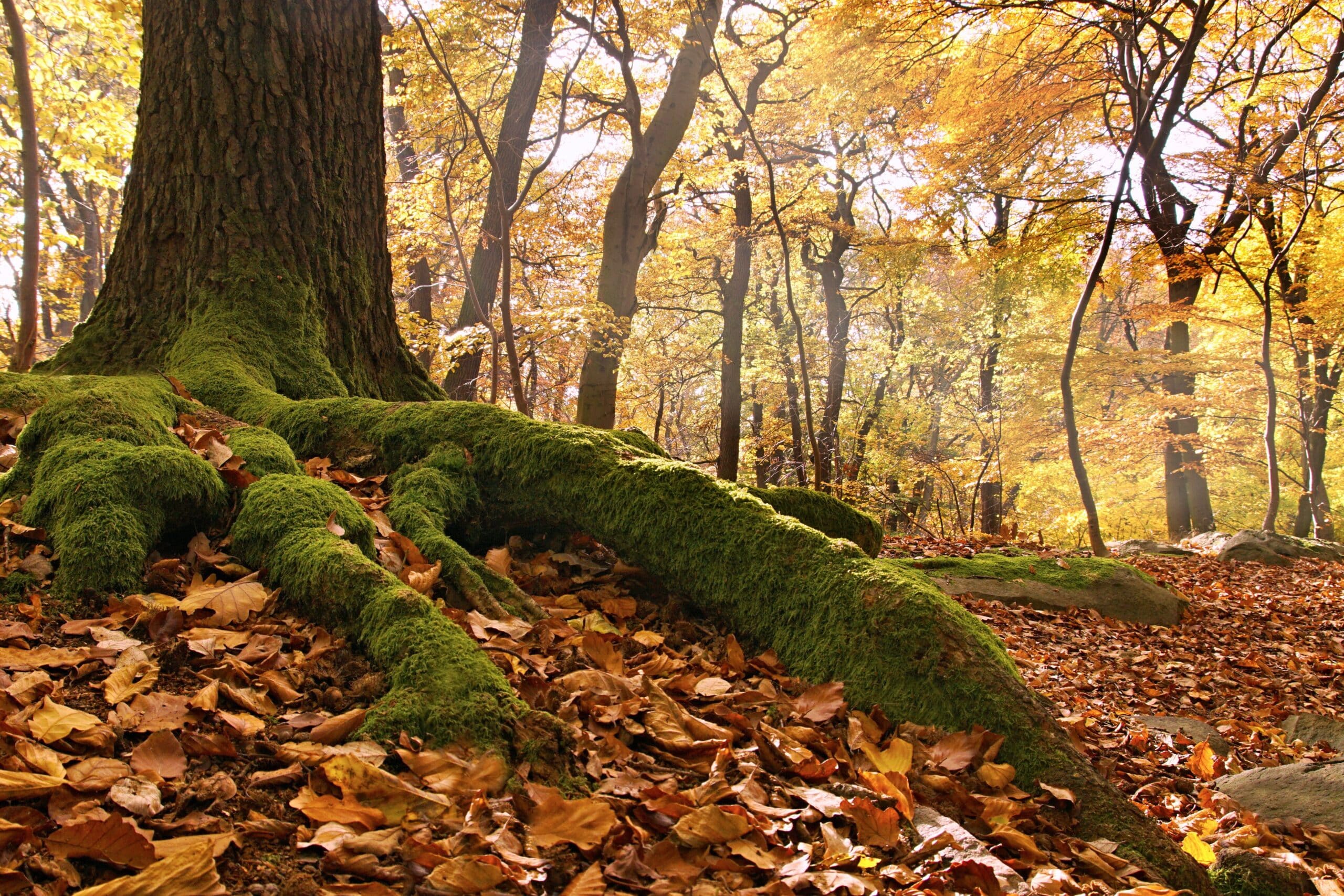
Mixed deciduous forests: All-rounders in climate change
- Humus formation: Leaves and branches fall to the ground and are decomposed by countless living organisms into fertile humus.
- Cooling effect: Leaves reflect sunlight and evaporate water through their leaves – this cools and also lowers the ambient temperature. Deciduous trees cool more effectively than conifers.
- Water storage: Mixed deciduous forests store rain, release some of it to groundwater and thus protect against flooding and drying out – better than coniferous forests.
- Resilience: Mixed deciduous forests with different species are more stable against storms, drought and pests, because the risk of damage is distributed across different species.
Monocultures: Little protection, high risk
Many forests today were established as managed forests – often with pines or spruces in neat rows. These monocultures:
- are more susceptible to storm, drought damage and pests,
- have a lower water storage capacity,
- harbour fewer species
- and are less climate-resilient than mixed deciduous forests.
Forest conversion close to nature
A climate-resilient forest of the future is species-rich and as close to nature as possible. Trinkwasserwald e.V. is committed to converting conifer monocultures into resilient mixed deciduous forests in order to protect wood, water and biodiversity in the long term.
Conclusion: Forests are not just a backdrop
Forests are active allies in climate change. Those who plant deciduous trees plant the future: through climate-resilient CO₂ binding and by strengthening natural, living ecosystems.
More forest. Water. Values.
- #Forest. Water. Values.
Mushrooms are among the oldest living organisms on Earth. Their history goes back more than one billion years – long before the first plants or animals existed. Fossil finds show that mushrooms were already present in the early developmental phases […]
- #Forest. Water. Values.
One hectare of drinking-water forest… … may sound unremarkable – about the size of one and a half football pitches -, yet something great is happening on this area: year after year, 500,000 to 1,200,000 litres more clean groundwater is generated here than in […]
- #Forest. Water. Values.
Trees are true masters of adaptation and survival Their growth is far more than an impressive natural phenomenon – it is the result of a long evolutionary development and the basis for the stability of entire ecosystems. […]