

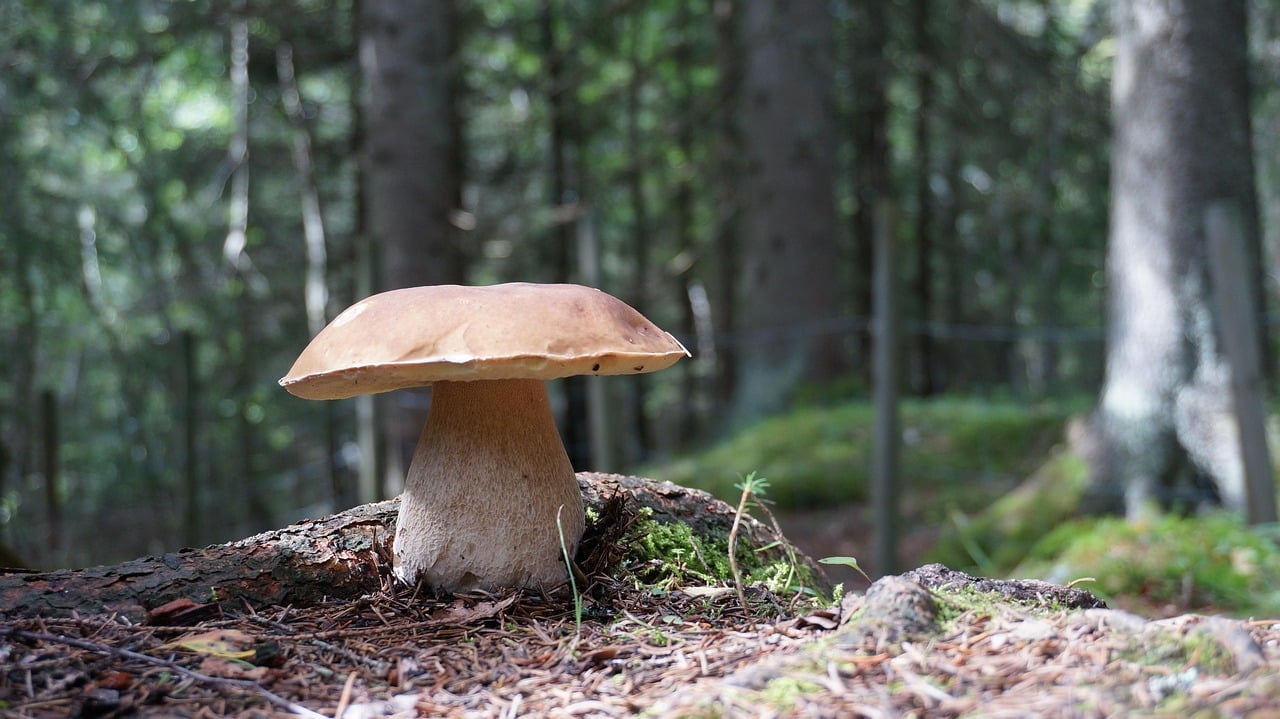
Fungi are among the oldest living organisms on Earth.
Their history stretches back over a billion years – long before the first plants or animals existed. Fossil finds show that fungi played a crucial role in the early stages of life: they helped break down rock and create the foundations for fertile soils. Without fungi, life on land would hardly have been able to develop.
Today we find fungi everywhere – from tiny yeasts to mighty bracket fungi. The latter form highly complex networks together with plant roots, subtly controlling the ecosystem. Through fine fungal threads in the soil, the so-called mycelia, trees and plants are connected. This “underground communication system”, the wood wide web, enables the exchange of water, nutrients and even chemical signals, through which plants cope better with stress or danger.
Fungi are true recycling geniuses:
- They break down dead wood, leaves and other organic matter and turn them into nutrient-rich humus.
- They bind carbon in the soil and help stabilise the climate.
- They promote water retention and improve soil structure – a crucial basis for healthy forests and sustainable terrestrial ecosystems.
Without fungi, the cycle of life would come to a standstill. They are the invisible architects of our forests, meadows and soils – quiet, effective and indispensable.
The loss of near-natural forest areas through deforestation, agriculture and urban expansion, as well as over-fertilisation with nitrogen and phosphate, which alter the soil environment, endanger the life of fungi.
Near-natural forestry, species-rich mixed deciduous forests with diverse symbiotic partners, deadwood, old trees and habitat trees with bark cracks or cavities, on the other hand, create habitats, including for rare fungal species.
If we protect the habitats of fungi, we protect the very foundation of life itself.
More forest. Water. Values.
- #Forest. Water. Values.
One hectare of Trinkwasserwald… … may sound inconspicuous – about the size of one and a half football pitches — yet something great happens on this area: year after year, up to 800,000 litres more clean groundwater are generated here on average than […]
- #Forest. Water. Values.
Trees are true masters of adaptation and survival Their growth is far more than an impressive natural phenomenon – it is the result of a long evolutionary development and the basis for the stability of entire ecosystems. […]
- #Forest. Water. Values.
Ferns are among the oldest groups of plants on Earth… … their history goes back more than 350 million years, to the age of the dinosaurs. Even then, they covered large parts of the planet and shaped the early […]